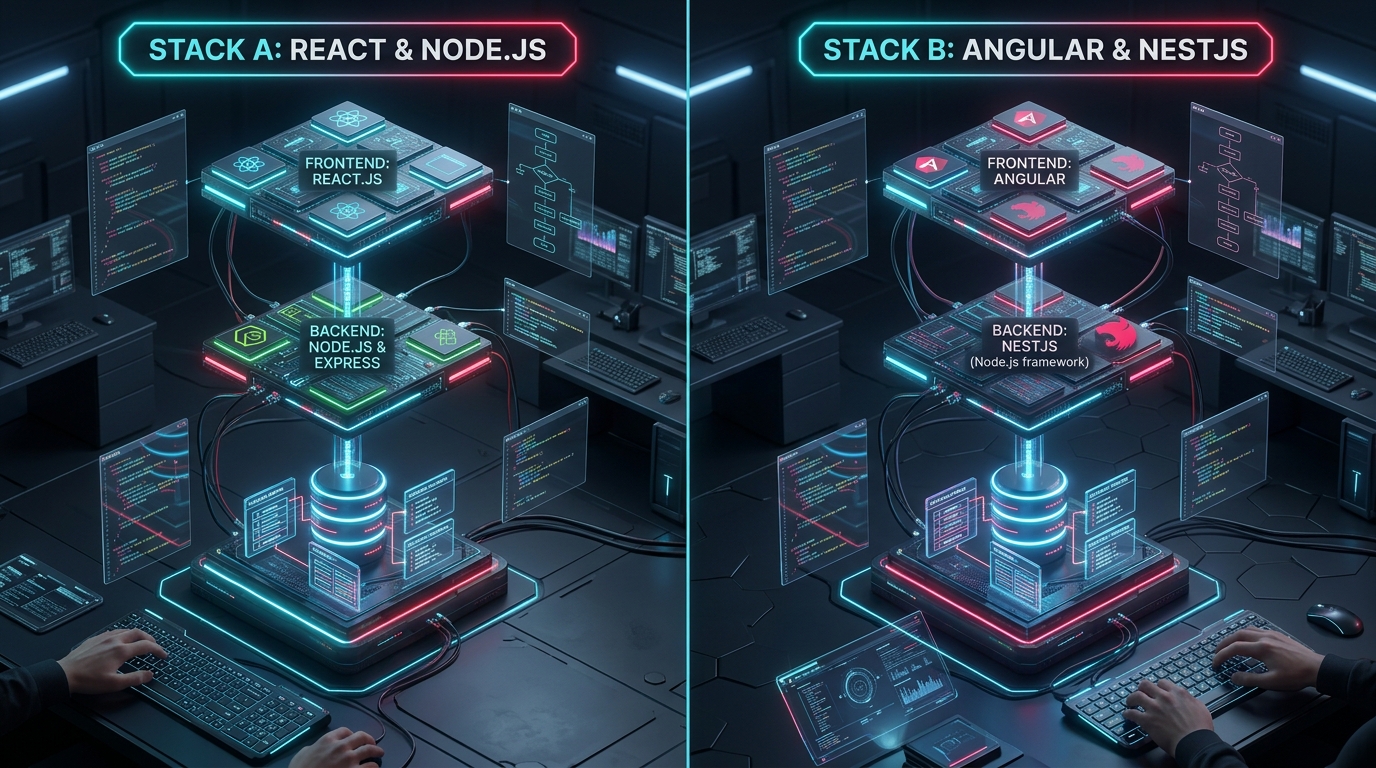
The MongoDB/Express/Node core is identical in both stacks — the real decision is React versus Angular on top, and that decision should follow your team’s existing frontend muscle memory, not a trend piece. If your engineers already think in components, hooks, and a loosely-opinionated file structure, React (MERN) will feel native. If they come from a background of strict typing, dependency injection, and framework-enforced structure, Angular (MEAN) will feel more familiar than fighting React’s flexibility.
Angular’s opinionated structure pays off on larger teams with rotating contributors. Because Angular enforces a consistent module, service, and component pattern out of the box, a new engineer joining a mature Angular codebase has fewer implicit conventions to learn — the framework has already made many of those decisions. This matters more as team size grows and more people touch the same codebase.
React’s flexibility pays off on smaller teams that want to move fast and pick their own state-management conventions. That same flexibility becomes a liability without discipline: two React codebases built by different teams can look almost unrelated in structure. If you choose React, invest early in agreeing on folder structure, state management (Context, Zustand, Redux Toolkit, or React Query depending on the use case), and component conventions before the codebase grows past a handful of contributors.
Neither stack solves a bad data model. Whichever you pick, the time you spend on your MongoDB schema design — or your decision to use a relational database instead — will matter more than the frontend framework choice. MongoDB’s document model is a strong fit for rapidly evolving product schemas and read-heavy workloads with nested data; it is a weaker fit for data with many-to-many relationships and strict referential integrity requirements, where PostgreSQL is usually the better choice regardless of which frontend framework you pick.
Consider your hiring pool, not just your current team. Engineers who list React on their resume significantly outnumber engineers who list Angular, in most markets. If you expect to grow the team through hiring rather than staff augmentation alone, that talent pool difference is worth weighing alongside technical fit.
In 2026, modern full-stack architectures frequently adopt Next.js 15 App Router on top of MongoDB or PostgreSQL, or NestJS for type-safe backend services when the team wants Angular-style structure on the backend even while using React on the frontend. NestJS in particular has become a common middle ground — it borrows Angular’s dependency-injection and module patterns for the backend, while leaving the frontend framework choice open.
TypeScript is no longer optional in either stack for anything beyond a small prototype. Angular ships with TypeScript by default; React requires you to set it up, but the ecosystem support (create-next-app, Vite templates) makes this close to zero-friction today. Whichever stack you choose, plan for TypeScript from day one rather than retrofitting types onto a growing JavaScript codebase later.
Testing philosophy differs subtly between the two ecosystems. Angular’s built-in testing utilities (TestBed, Jasmine/Karma historically, increasingly Jest) are more prescriptive about how you structure tests. React’s testing story (Jest, React Testing Library, Vitest) is more flexible but requires the team to agree on conventions — similar to the state-management question above.
If you are migrating an existing application rather than starting fresh, the calculus changes again: a partial rewrite that keeps your existing backend and swaps only the frontend framework is a very different project than a full-stack rewrite, and the risk profile of each should be scoped separately before you commit to either stack.
The honest answer to “which stack is better” is that both are production-proven at scale, and the teams that struggle are rarely struggling because of the framework — they are struggling because of unclear ownership boundaries, inconsistent conventions, or a data model that was never revisited as the product grew.